


I tested the AI virtual receptionists and figured out what works best for my business. I have spent weeks testing each one of them and also cross-checked the reviews on Software Advice, G2, Capterra and Trustpilot.
What I discovered is, I didn’t rely on human agents to support my customers 24/7 across phone, chat or website. The AI receptionist gave a real-time response to my customers almost instantly.
In this article, I’ll show you how these AI virtual receptionists benefited my business by acting as a first touchpoint for all customers. I will clearly explain in what areas each AI receptionist provider works well, and where it lags.
TL;DR: The 5 Best AI Receptionists in 2026
Explore the best AI receptionist for enterprise, based on the 28+ models that our team has tested and reviewed.
| AI Receptionists | Best For | Prices |
|---|---|---|
| 1. MirrorFly | A fully custom and white label AI agents | Custom quote |
| 2. Apphitect | The Self hosted scalable AI phone receptionist | Custom Price |
| 3. RingCentral | A highly secure AI front desk agent | $59/month |
| 4. Dialpad | Next-Gen voice receptionist for enterprise apps | Talk to Sales |
| 5. Zendesk | Leading AI answering bot for any use case | Talk to Sales |
| 6. Futuro AI | Build a Human Like AI Receptionist | Custom pricing |
| 7. Nextiva | Conversational Front-desk Agent | Starts at $99/month |
| 8. CloudTalk | Voice AI Receptionist for Sales & Support Teams | From $25/user/month |
| 9. Luma Health | AI Medical Receptionist | Not available |
| 10. Vapi | Customizable AI Voice Agent | Custom price |
| 11. Smith.ai | AI Live Human Agent | Starts at $95/month |
First, we will cover MirrorFly,
10 Best AI Receptionist Providers in 2026 Reviews
I tested multiple AI receptionists myself, and here are the ones I discovered to be the best: MirrorFly, Apphitect, RingCentral, Dialpad, Zendesk, and Vonage.
1. MirrorFly: #1 AI Virtual Receptionist
In the past years, I have used RingCentral, Vonage, Dialpad, and Zendesk as AI receptionist. But I could not find a solution that suited the unique needs of my business.
Then I picked MirrorFly, a self-hosted AI virtual assistant for building my own AI receptionist. It offered a white-labelling option, therefore, I modified the logo and theme of the AI agent to match my business.
MirrorFly’s built-in NLP and NLU for voice was impressive. The assistant understood my customer’s accents, tone, and context and responded naturally. On top of that, it seamlessly handled all my inbound support calls, routing them intelligently based on intent.
Combined with its 1000+ AI-powered features, I felt like I had a smart receptionist working for my business. I had full source code access and it gave my developer complete freedom to customize call flows, security rules across web & mobile apps.
Usually, each time I use a virtual assistant, I adjust to a provider’s limitations. But MirrorFly handled multi-language conversation, and the AI intent recognition delivered a dynamic experience. That’s the big reason I chose MirrorFly as the best of all.
Standout Features of MirrorFly AI Receptionist
- Agentic AI Platform
- AI Voice Agents
- AI Contact Center
- AI Video KYC
- AI Consultation System
- Speech-to-Text SDK
- NLP & NLU for Voice
- Takes & Makes Real Calls
- Handles Inbound Support Calls
- Full Source Code Ownership
- Native & Hybrid Languages
- Scale 1 billion Conversation
- SIP & VoIP Integration
- Built-in Transcript Summaries
- Multi-Tenant Management
What I Liked
- 100% Customizable Solution
- Flexible hosting (On-prem/ Cloud)
- Internal knowledge base search
What I Disliked
- Automatic digit pressing is in beta
2. Apphitect: Scalable AI Phone Receptionist
I chose Apphitect as the second best AI Virtual Receptionist, as it was moreover equivalent to MirrorFly. Apphitect’s secure AI receptionist helped me create a voice assistants that talk like a human. It was a fully customizable solution and offered 500+ AI-powered features.
Apphitect AI receptionist listened and asked the right follow-up questions, similar to a trained human front-desk staff. What impressed me was the real-time responsiveness. Replies came under 500ms and made the conversations feel interactive.
It integrated SIP/VoIP and leveraged AI capabilities to create intelligent voice agents while retaining full source code ownership. Apphitect was the one virtual receptionist what I needed to build for my business. It didn’t restrict me, I hosted initially on Apphitect’s Cloud and later on my own servers.
Standout Features of Apphitect
- Conversational AI
- AI Chatbots
- Noise Level Analysis
- Escalation to Human Reps
- Audio Latency Monitoring
- Qualifies Leads, Books Meetings
- Handles Pauses & Interruptions
- Advanced Custom Security
- Support 100+ Integrations
- Multi-Tenant Architecture
What I Liked
- White-labeling options
- LLM-powered conversations
- Human-like natural voice
What I Disliked
- In-call conversational routing is in beta
3. RingCentral: Secure AI Front Desk Agent
I started using RingCentral’s voice-driven receptionist three months back. The conversational AI has been able to resolve more than half of our inbound queries instantly. It included 100 AI-handled call minutes each month. But additional call minutes were billed at $0.50/minute.
This led to an increase in our cost during high-volume periods, which I would say is a drawback. Still, their ability to integrate with Google Calendar and Outlook for real-time appointment increased the booking rate. The AI Receptionist and RingSense AI helped our sales team streamline call handling.
Standout Features of RingCentral
- AI-powered Coaching
- Cloud-based Phone System
- External Guest Collaboration
- Multi-level Auto Attendant
- Interactive Voice Response
What I Liked
- Resolved routine inquiries using FAQs
- Auto update on sales CRMs
- Eliminated rigid phone tree menus
What I Disliked
- Complexity in IVR setup
- High price for add-ons
- Long time for deployment
4. Dialpad: Next-Gen Voice Receptionist
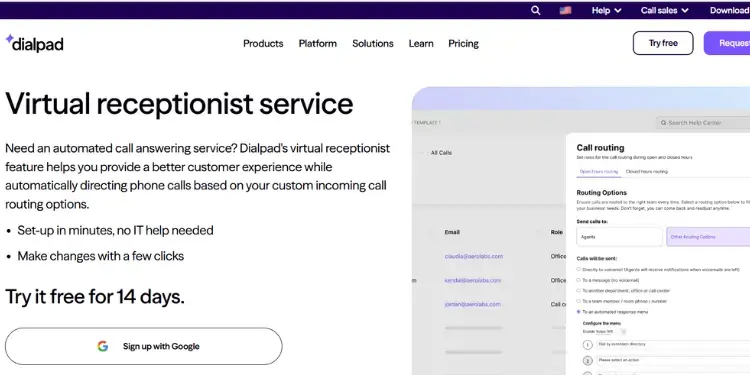
I purchased Dialpad’s standard package. Its deep semantic search capability resolved my customer queries quickly and reduced the need for human agents. The AI Recaps was helpful for generating real-time transcription and instant call summaries.
As Dialpad’s PBX, UC, and contact center apps are built on the Google Cloud Platform, it didn’t limit us from scaling the business. As weeks passed, my business relied heavily on Dialpad AI agent, and it gave us clear insights even during peak hours.
Standout Features of Dialpad
- AI-powered Analytics
- AI Agent Assistance
- Analysing Live Sentiment
- Real Time Call Transcription
- Automatic Post Call Summary
What I Liked
- Lowers contact center costs
- Provides real-time insight
- Detects personal information
What I Disliked
- Limit video meeting to 10 users
- Call centers audio delays
- Minor bugs & performance issues
5. Zendesk: Leading AI Answering Bot
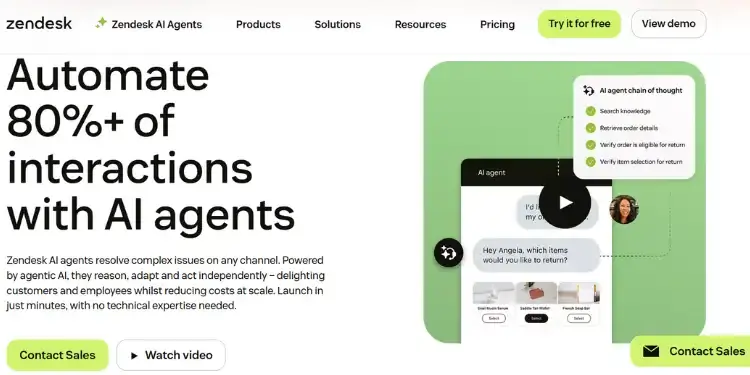
If you ask me one platform where call experience feels more natural without customer facing chunky IVR, I would say it’s Zendesk’s AI Answering Bot. It only escalated to our human agent when needed, and has reduced the workload for my team.
What I appreciate most is Zendesk consolidated email, chat, phone calls, web messages and more channels into one interface. It’s actually powered by Poly.ai and resolved nearly half of my customer calls on its own. From day one, the AI model was very intuitive and purpose-built for CX.
Standout Features of Zendesk
- Omnichannel Support
- Intelligent Ticket Routing
- Self-Service Knowledge Base
- Custom Performance Dashboards
- Integrate 1000+ Third-party Apps
What I Liked
- Instant call insights
- AI-assisted summaries
- Voice QA auto-scoring
What I Disliked
- High agent cost
- Complex setup process
- Limited gen AI features
6. Futuro AI
Futuro AI builds a variety of intellectual property focused on building AI receptionists with the purpose of sounding indistinguishable from humans and allowing small businesses to have 24/7 customer service, lead generation and generating sales. Several technologies are the driving factor behind the company’s ability to deliver AI receptionist that in a 2025 double blind study at 1000 people 94% of those tested thought they were speaking to a human and not AI.
The first is VoiceAlive, the proprietary voice engine that utilizes controlled disfluencies, characteristics such as the AI replicating human speech like deep breaths, insertion of “umm’s” and filler terms, and a range of vocal tones.
Futuro’s MasterMind technology is a proprietary knowledge base system that utilizes decision trees instead of traditional, RAG to give each AI receptionist a more sophisticated method of delivering information which leads to more thorough and sophisticated answering capabilities.
Standout Features of Futuro AI
- Voice Realism Technology
- Agent Customized Per Client
- Custom Analytics
- Speaks 53 Languages
- Agent Memory System
What I Liked
- Agent sounded remarkably human
- Custom knowledge base architecture
- Numerous software integrations
- AI recalls all previous conversations
What I Disliked
- Longer set-up time (24-48 hours)
- Pricing varies depending on configuration
- More expensive than other options
7. Nextiva: Conversational Front-desk Agent
I used Nextiva’s virtual receptionist last month to handle business calls and improve customer support. Its XBert AI is an autonomous agent that answers routine questions, routes callers, and reduces the workload of our team.
The AI agent gave personalized replies to the callers. Even though the setup was smooth, configuring advanced call flows needs some time. Regarding the pricing, a $99/month plan is available. This includes up to 100 resolutions, including calls, texts, or chats.
Standout Features of Nextiva
- Smart appointment scheduling
- Lead qualification & follow-up
- Multi-channel support
- Answer calls & messages instantly
- Real-time insights & summaries
What I Liked
- Reduced manual call handling
- Personalized caller experience
- Easy integration with CRM platforms
What I Disliked
- Premium features increase the cost
- Advanced call flow setup requires effort
- Limited customization in a few workflows
8. CloudTalk: AI Receptionist for Sales & Support Teams
CloudTalk’s voice agent helped to answer incoming calls and improve response time across our support team. The virtual receptionist handled call routing, qualified leads, and scheduled appointments 24 hours a day.
The analytics and call monitoring features provided useful insights into team performance. However, some advanced capabilities required a plan upgrade. This led to an increase in the overall cost.
Standout Features of CloudTalk
- Intelligent call routing
- Interactive voice response
- CRM and helpdesk integrations
- Spam and robocall blocking
- Understands multi-languages
What I Liked
- Captures intent instantly
- 24/7 inbound call coverage
- No complicated setup
What I Disliked
- High cost pricing for advanced features
- Time-consuming IVR configuration
- Occasional call quality issues
9. Luma Health: AI Medical Receptionist
I chose Luma Health AI receptionist to automate patient scheduling and call routing needs in the business. It integrates directly with the EHR platform and is designed specifically for large health care organizations.
Most of the call center tasks and routine inquiries were automated. The AI also assists with insurance eligibility verification and co-pay collections before visits.
Standout Features of Luma Health
- Omnichannel conversation
- Smart waitlist management
- Automated reminders
- EHR integration
- Automated patient scheduling
What I Liked
- Reduced Admin Burden
- HIPAA-Compliant Platform
- Multilingual Capabilities
What I Disliked
- Complex Custom Workflows
- Initial Setup Needs Time
- Not ideal for small clinics
10. Vapi: Customizable AI Voice Agent
Vapi’s virtual receptionist helped us to answer inbound calls, resolve FAQs, and schedule appointments in real-time. I noticed that Vapi’s AI agent eliminated delays during calls. It gave our developers complete control over STT, LLMs, and telephony integrations. The per-call minute rate is $0.05.
Standout Features of Vapi
- CRM Auto-Logging
- AI Guardrails
- Multilingual Support
- Handles Interruption
- Human Call Transfers
What I Liked
- Natural Conversation Handling
- Scalable infrastructure
- Customization option
What I Disliked
- Variable Pricing Model
- Needs Technical Expertise
- No Built-In Industry Templates
11. Smith: AI Live Human Agent
Smith.ai’s virtual receptionist is suitable for law firms, home service contractors, and marketing agencies. It helps with qualifying leads and booking appointments.
This North America-based agent handles routine interactions and streamlines front-office workflows. The pricing plans start at $95 per month. It charges per-call rather than per‑minute.
Standout Features of Smith
- Hybrid AI & Live Agent
- Lead Qualification
- Third-party Integration
- Outbound Calling
- Warm Phone Transfers
What I Liked
- Deep CRM Tool Sync
- Instant Call Summaries
- Free Spam Blocking
What I Disliked
- Expensive Baseline Costs
- No Omnichannel Support
- Not Ideal for Short Calls
How I Define An AI Receptionist?
According to me, an AI virtual receptionist is a software that handles front-desk tasks using NLP, ASR and TTS technologies. Its purpose is to understand my customer queries and assist them instantly through chat, voice and video call, similar to a human receptionist.
I have used this AI receptionist to route calls, schedule appointments, verify visitors, collect information, and most commonly used it to answer inquiries of my customers.
How Do AI Receptionists Work?
While testing, I was curious to understand how the virtual receptionist works using artificial intelligence technologies. What I learned was, when my customer interacts with the AI receptionist, the system operates in a continuous cycle involving these five layers:
- Speech-to-Text (STT)
- Natural Language Processing (NLP)
- Decision Engine
- Integrations & Workflow Automation
- Text-to-Speech (TTS)
Let’s first cover speech-to-text
- Speech-to-Text: Speech-to-text converts customers’ spoken words into a real-time transcription with over 95% accuracy. Some customers were talking with background noise, most of them had different accents, and still, the AI understood them.
- Natural Language Processing: It analyzes my customers’ words, sentence patterns, or key terms and understands what they actually need. Basically, the intent detection happens here and allows AI to respond to customer questions.
- Decision Engine: At this layer, the AI decides if the call should be escalated to a human agent. It includes the context to pick up right where the AI assistant left off, without making my customer wait for a long time.
- Integrations & Workflow Automation: The AI receptionist connects its activities with CRM, calendars, ticketing systems, and internal communication platforms, providing accurate info for my customers. This automated most of our businesses’ repetitive tasks.
- Text-to-Speech: After the NLP engine prepares a response, TTS, along with Machine Learning algorithms, generates human-like speech. Here, deep learning models are used in the speech synthesis process.
My finding was that each AI receptionist I tested kept learning from my customer’s past interactions. And it processed the context and delivered a more accurate solution over time. In the whole process, the voice AI relied on STT and TTS, from handling calls to voice conversations.
Note: Here is what I have learned after testing 28+ AI receptionists and concluding the top 5 providers among them:
- Best AI receptionists deliver a human-like voice
- Enterprise-level guardrails ensure no hallucination
- Latency monitoring cannot be ignored from day one
- Real-time CRM interaction (API) matters most
- Multilingual AI receptionist is essential
10 Key Capabilities of AI Receptionist I Relied On:
I observed the following capabilities in the best AI virtual receptionist, and personally believe small and medium enterprises will adopt this solution.
- Personalized Conversations: It made each interaction feel personal and relevant to my customers’ needs based on the past data or context.
- Sales & Support Automation: AI receptionist automated the workflows. It handled inquiries with accurate responses, reducing workload of our human agents.
- Multilingual Conversations: My customer base was from different regions, and the virtual assistant also responded in multiple languages. This helped me serve our global customers.
- CRM & Ticketing Integration: I connected the receptionist to my CRM. It instantly logged calls, updated leads, added meeting summaries, and created support tickets. No manual effort.
- Unified Agent Solution: All complex call flows happened in one platform, including both AI and human agents working together for consistent service.
- Sentiment Analysis: Whenever frustration or urgency was detected, the AI receptionist would adapt its tone and respond more effectively.
- Handles Interruptions: Callers interrupt at any point, and the AI understood it and kept the conversation flowing naturally without losing the context.
- Human Escalation: It routed urgent calls to the right department/human agent. From there human would carry on the interaction.
- Automated Booking: The AI scheduled appointments directly over the phone. It synced with the calendar and my customers could check their availability, reschedule or cancel it.
- Identity Verification: With this integration, AI confirmed callers before sharing sensitive info. It also managed visitor check-ins and streamlined my front-desk tasks.
AI vs Human Receptionists: What Two Differences I Observed
A human receptionist cannot compete with all AI-powered capabilities. And if you ask me, what limitation does the AI assistant come up with, it’s the data dependency.
I once encountered in my business, when a customer asked for loan interest, AI hallucinated with the outdated percentage. While investigating, I found its training data contained old internal doc.
From then onwards, ongoing model training was prioritized, and we adopted a hybrid model to combine the strengths of human and AI receptionists.
Our business saw a monthly savings of 79% when we switched to an AI receptionist, similar to how Thomas Samuelson Accounting gained this advantage.
5 Ways AI Receptionist Improved My Business Efficiency
I didn’t see the AI receptionist merely as a tool for reducing operational costs. It also automated repetitive tasks and was a strategic differentiator for my business in last 2 years.
- Real-time response 24/7: What happened when human agents not available full-time? I saw a drop in calls & missed customer inquiries. But with this AI, there was zero latency in routing.
- Handled unlimited call volumes: Doesn’t matter how much inbound calls my business received, it helped my team grow without limit. It’s ideal for multi-location businesses as well.
- Consistent & error-free interaction: Responses generated from my version controlled knowledge base. Workflows got automated & lead-response speed and conversions improved.
- Improved customer experience: Based on historical interaction data, it delivered personalized guidance at every step, even with many concurrent customers.
- Centralized communication: Without unifying the customer interactions across call, chat, email, we would have faced difficulty in managing and scaling our business.
Top 6 Use Cases of AI Receptionists Across Industries
Based on my real-time business experience working with the AI receptionist, I have listed the various use cases.
| 1. Healthcare | Delivers human-like voice assistance for handling appointments and sending reminders |
| 2. Hospitality & Travel | Assists with guest check-ins, reservation support, and concierge requests |
| 3. Real estate | Guide buyers and renters for property inquiries, schedule visits, and help with qualifying the leads |
| 4. Enterprises | In corporates, the AI-powered voice tools act as front-desk automation and applicable for internal communication |
| 5. E-commerce | Instant voice assistance helps shoppers with order tracking, returns, and FAQs |
| 6. Call Centers | Automate routine inquiries, bookings, and support teams with real-time prompts and call routing |
Top 7 Features I Looked For In An AI Receptionist
Apart from the features of chat, voice, and AI-powered video call capabilities, I prioritized the following top features for my AI voice receptionist.
- Personalized AI Agents: I wanted my AI receptionist to match my business needs and workflows. When I tailored its features, it made the entire experience feel truly mine.
- On-premise Hosting: I preferred an on-prem setup as it gave me full data ownership & control over security. It met compliance needs that cloud-only platforms couldn’t handle.
- Behavior Customization: The AI should sound the exact tone and be in the personality how my brand wants to. I set rules and fallback logic as I intended.
- Pre-built Templates: This saved me hours during setup by giving ready-made conversation flows and industry-specific scripts. I could just tweak based on my needs.
- Data Encryption: We handle sensitive information, so I needed end-to-end encryption and data control option. Thus, every call and transcript will remain compliant.
- Real-Time CRM Interaction: Instantly, I want the customer data to get updated & retrieved. This can be achieved by integrating with calendars, CRMs, and communication apps.
- Analytics Dashboards: With the real-time analytics dashboard, I tracked call volumes and the performance insight helped me refine AI agents and improve efficiency.
4 Steps to Implemented AI Receptionist In My Businesses
I have put down the step-by-step process to build the AI receptionist using MirrorFly SDK, that delivers accurate and human-like responses.
- Step 1: Assessing My Business Needs
- Step 2: Choosing AI Models & Integrating MirrorFly
- Step 3: Training AI Model Using FAQs & Customer Data
- Step 4: Testing & Optimizing Conversation Flows
First Step, We will explained below,
Step 1: Assessing My Business Needs
I asked the following questions before getting started. This helped me understand what I wanted from the AI receptionist for my enterprise business.
- Which platform I miss the customer communication?
- What will my AI receptionist handle?
- What were the peak call hours? common FAQs?
- Should I integrate a CRM or ticketing system?
- What compliance requirements my business need?
Step 2: Choosing AI Models & Integrating MirrorFly
Now, I chose the core AI models such as Speech-to-text, NLP/NLU, Text-to-Speech, ML and combined the AI models to build the virtual assistant.
For real-time communication, I used MirrorFly voice agent SDK to get the speech data from conversations for STT and NLP.
I signed up and logged in to the MirrorFly account. Got the license key and initialized MirrorFly SDK using the authentication token. Then the chatbot connected to MirrorFly’s real-time communication features for in-app chat, voice, and video interactions.
Step 3: Training AI Model Using FAQs & Customer Data
I collected the FAQs, policy documents, product manuals, and all necessary documents of my business and fed into the agent’s custom knowledge.
I removed unnecessary elements such as special characters and excess white spaces to organize them as informational chunks.
I used Hugging Face Transformers for automating sentiment labeling. BERT Multilingual helped me extract sentiment when dealing with different languages.
With this refinement, I could see AI receptionist becoming more context-aware. My goal was to reduce hallucinations and ensure conversation remained consistent.
Step 4: Testing & Optimizing Conversation Flows
Now I tested if the AI model adapts to my business domain, handles memory/context window, delivers low latency, and human-like responses. I checked if it supports the AI moderation layers and auto-scales for heavy traffic.
Based on new customer queries, I then optimized the AI model. Also, the PCA technique helped me save memory and increase the search speed in the RAG system.
My Prediction On This Technology
Now, the industry-specific AI receptionist replacing generic bots is already booming as a trend. AI assistants will become more emotionally aware in near future.
The vision agents will handle more complex tasks in industries such as healthcare and manufacturing. And, in my opinion, the voice cloning technology will be heavily relied upon for natural human-like conversations.
Final Recommendation
Among the list of AI virtual receptionists, I recommend you try MirrorFly and Apphitect. For the past two years, my business service to customers has been instantly responsive. I had the freedom to customize my AI assistant as per my needs. I had all the control over infrastructure and full access to the API’s source code.
In the future, for delivering a hyper-personalized experience to my customers, I would still rely on MirrorFly. What impresses me the most is, you can use their self-hosting option to deploy it on your own server or on their cloud.
- Top 10 Custom AI Voice Agents
- Best White Label AI Outbound Calling Agents
- Top AI Agent Development Companies
What happens if we mess up with credentials on n8n if we are hosting multiple
clients?